Five stages of project management life cycle: your simple guide

If you think about it, many projects that go awry do so not because teams behind them lack the chops or motivation. More often than many want to admit, projects go off the rails because people are unclear about the goals, communication breaks down, and small problems are put on the back burner until they turn into costly-to-fix issues. That's why it's so crucial to adopt a structured, multi-step project life cycle management framework.
If you break the project into five clear project life cycle phases, at the very least, you'll be better equipped to handle the chaos that tends to follow. At the very best, you can set up the necessary internal processes to keep work organized, visible, and easier to control from start to finish, which would ultimately lead to project success.
TL;DR:
- According to the Project Management Institute (PMI) and the PMBOK® Guide, project management is organized into five process groups: initiating, planning, executing, monitoring and controlling, and closing. These are often used to describe the stages of the project life cycle.
- Each project life cycle phase entails a distinctive set of key activities, deliverables, project management software, techniques, roles, and responsibilities, which can vary depending on the applied methodology.
- In Waterfall, project life cycle stages are followed in a strict linear sequence with heavy upfront planning, while in iterative and incremental approaches, they are repeated in cycles with continuous delivery and adaptation.
What is a project life cycle?
A project life cycle is a series of phases that a project goes through from its inception to its completion. Each phase in the life cycle serves a specific purpose and includes distinct activities and deliverables that contribute to the project's overall success.
While projects may take different forms depending on the industry or project management methodology, PMI’s process groups provide one of the most widely used frameworks for managing work from A to Z. These process groups are not strictly “phases,” but they are often used to describe how project activities are organized and executed over time.
The typical project phases of a PMI project life cycle diagram are:
- Initiation
- Planning
- Execution
- Monitoring and Controlling
- Closure
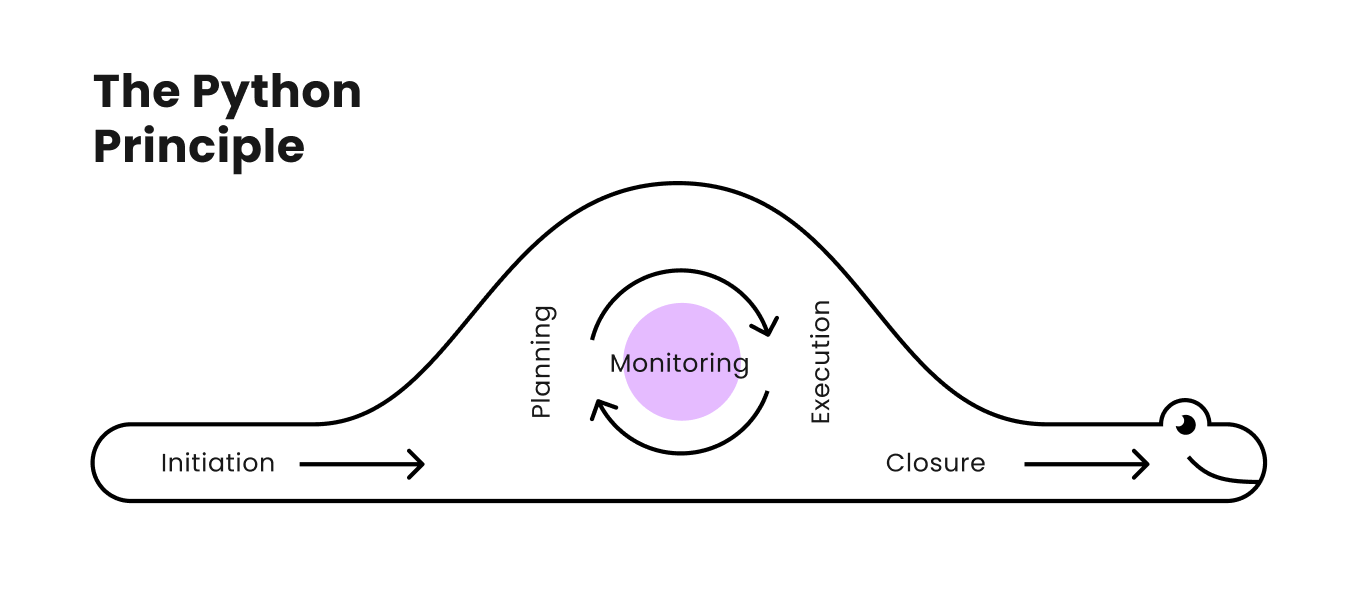
The concept of the project life cycle is perfectly represented by the Python Principle that we explored earlier in our articles. This principle visualizes a project as a python with a tail that stands for the initiation phase, then there is a heap with a prey inside that represents such stages as planning, execution, and monitoring all circulating in the Deming cycle, and, finally, a head that stands for the project closure.
Stage 1: Initiation
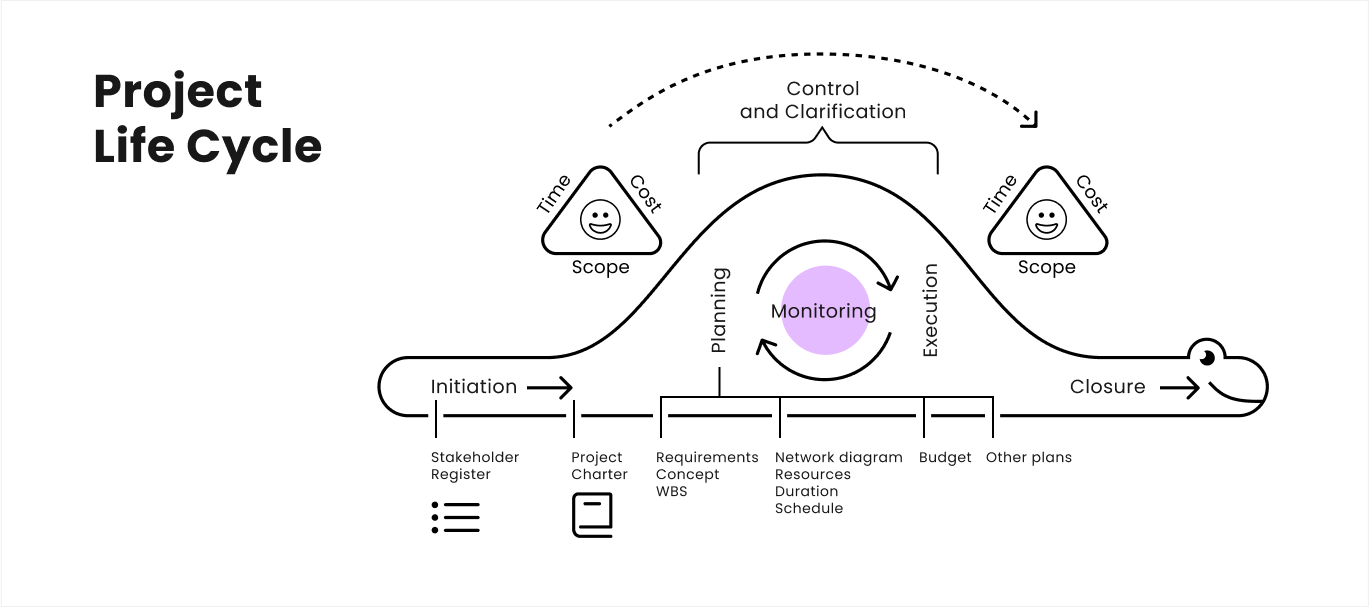
Project initiation is the first phase of the project life cycle, where you decide whether to launch the project and, if you do, lay the groundwork. During the initiation phase, the team determines the viability of the project, i.e., whether they have the necessary competencies, resources, and time according to the project management triangle.
This stage is all about close communication with the project sponsor to figure out whether the project is worth pursuing. It also includes early conversations around the project time and resources.
Once the project gets the green light, two very important artifacts finalize this stage:
- Project Charter. This document formally authorizes the project, grants the project manager authority, and aligns the sponsor and the project manager on expectations and commitments. The charter is developed according to the Egg Principle, where the team establishes the project's boundaries (the shell) that must not be exceeded.
- Stakeholder Register. After identifying all parties affected by the project, including customers, team members, and other stakeholders, and understanding their needs, expectations, and influence on the project, the information is compiled into a stakeholder register.
Stage 2: Planning
During the project planning phase, plans and schedules are developed to guide the project team in executing the project effectively. By plans, we don't mean outlining every aspect of the project plan upfront. This is impossible because projects, by definition, deal with project tasks that can't be fully broken down in advance. Instead, the team drafts an initial, high-level version of the plan that aligns with the boundaries and objectives defined in the project charter.
The planning phase includes the following components:
- Scope Definition. Before the team starts working, they refine the scope outlined in the charter. There are three steps to scope management: gathering requirements from the stakeholders into a requirement matrix, creating a comprehensive scope statement, and building a Work Breakdown Structure (WBS).
- Network Diagram. The lowest-level elements of the WBS are used to map task dependencies in a network diagram. This helps establish the sequence of activities, starting with immediate tasks and expanding progressively through rolling wave planning as more detail becomes available.
- Resource Allocation. Once the work is defined, the necessary people and resources are added to the plan.
- Duration Estimation. The project team members estimate the duration of tasks and compile a schedule. If the timeline does not fit constraints, schedule compression techniques might help to align both.
- Project Schedule. A project schedule outlines the start and end dates for all project activities. Critical Path Method (CPM) and Gantt charts techniques can be used to visualize the project timeline.
- Cost Estimation. The financial resources required for the project are factored in and compiled into a project budget that outlines the cost baseline and funding requirements.
Besides the core planning elements, effective project management also demands supporting project documentation related to project risk management, procurement, quality management, and communications.
- Risk Management Plan. Before the start, the team also identifies potential risks that could impact the project. The risk management process includes risk identification, qualitative risk assessment (aimed at reducing the risk list), quantitative risk assessment, mitigation strategies, and contingency plans.
- Procurement Management Plan. This artifact outlines the goods and services required from external vendors and also describes the procurement processes, contracts, and vendor management strategies.
- Quality Management Plan. This defines the project's quality standards and criteria, while also establishing processes and metrics for ensuring that project deliverables meet the required quality standards.
- Communications and HR Management Plans. A communication plan outlines how information will be shared with stakeholders, including the communication channels, frequency, and formats to ensure effective information flow.
The main deliverable of the planning phase is the project management plan that integrates and consolidates all subsidiary plans and baselines. Typically, teams also include plans for scope, schedule, cost, quality, resource, communication, risk, procurement, and stakeholder management in this final document to make sure that all team members and stakeholders have a clear understanding of how the project will be carried out.
Stage 3: Execution
Once the team is done drafting initial plans, they usually hold a kickoff meeting to make sure everyone understands the plans and is on the same page. After the project begins, the team continuously refines the plans, except for the charter.
During the project execution phase, a project manager is the one in charge of removing obstacles, facilitating efficient work, and organizing effective communication. They make sure everyone has the information they need, while also managing stakeholder expectations, motivating the team, and handling conflicts.
Stage 4: Monitoring and controlling
Project execution usually involves a lot of changes and maneuvering, which inevitably leads to plan, schedule, and risk adjustments. The project monitoring and controlling phase helps the project remain on track and within scope despite all those tweaks. During this stage, the team tracks, reviews, and regulates the progress and performance of a project — and also identifies any areas where changes to the plan are required.
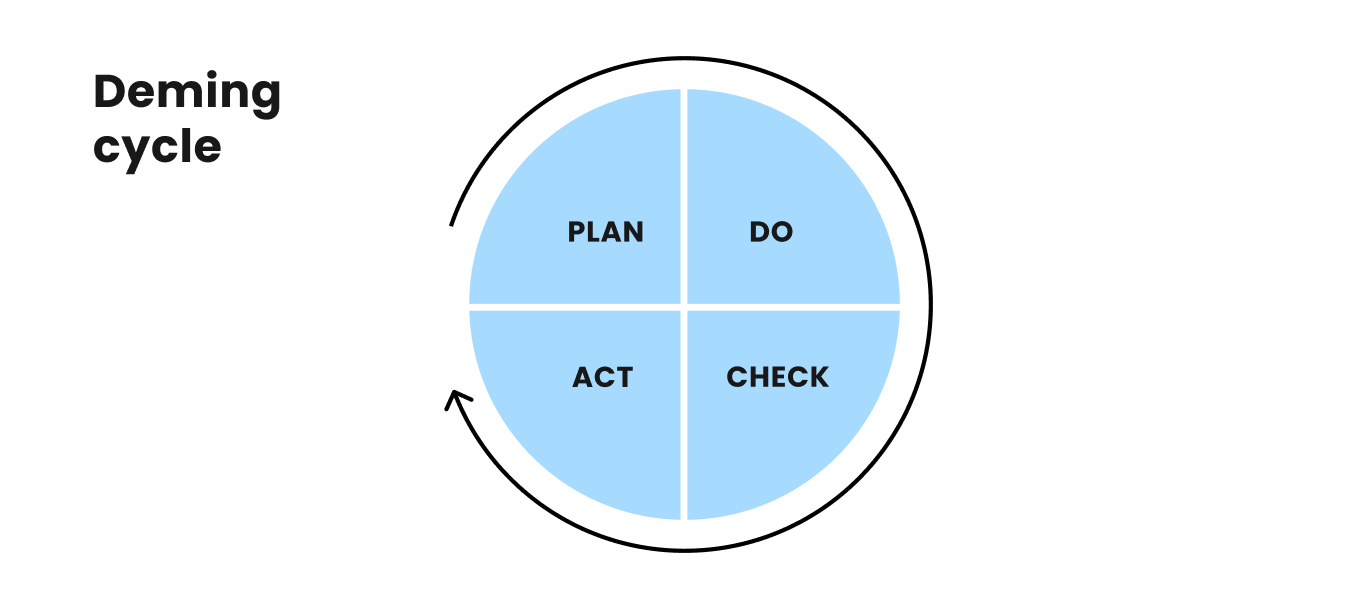
Key performance indicators (KPIs) and project milestones are used to measure progress. Regular status meetings and reports help uncover issues early, allowing for timely corrective actions. This phase aligns closely with the Deming Cycle (Plan-Do-Check-Act) and reflects the importance of continuous improvement through regular reviews and adjustments.
Continuous improvement is a fundamental aspect of successful project management. However, the need to update the project plan shouldn't be based on gut feeling or subjective judgment. It stems from the key deliverables of this stage:
- Performance Reports. This artifact provides a detailed analysis of project performance data, including Earned Value Management (EVM) reports, trend analysis, and forecasts to track progress against the project plan.
- Risk Register Updates. Within this document, the team maintains and updates records of identified risks, their responses, and current status, enabling proactive risk management and mitigation.
- Quality Control Reports. Here, the team jots down the results of inspections, tests, and audits, ensuring that project deliverables meet predefined quality standards, and all areas for improvement are on the team's radar.
- Stakeholder Feedback. The needs and expectations of key stakeholders also shape the plan adjustments.
- Project Milestones Updates. Meeting or failing to meet project milestones can indicate whether the team is heading toward successful project delivery or whether the plan needs adjustments.
Stage 5: Closure
The project concludes with closure, during which the team ensures that the pre-defined successful outcomes have been delivered within the defined constraints of project scope, time, and cost. This phase confirms that the project deliverables meet the desired quality standards and that all contractual obligations have been fulfilled.
The Final Project Report becomes the key deliverable of the closure stage. It encapsulates the entirety of the project's life cycle, serving as a definitive record of its execution and outcomes. This report includes a detailed summary of the project's objectives, scope, timeline, and key deliverables, offering a clear comparison between planned and actual performance. It highlights the successes and achievements, showcasing how the project met or exceeded stakeholder expectations.
By providing an in-depth analysis and reflection on the project, the Final Project Report not only marks the formal closure of the project but also acts as a valuable resource for future projects, enabling continuous improvement and organizational learning.
Project life cycle in other methodologies
At a high level, the project life cycle looks similar across methodologies. But if we peer into every methodology, we'll see that the main differences are in how ****linear, iterative, or adaptive the project life cycle phases are, and how much change is allowed during the project progress.
The predictive (Waterfall) project lifecycle
The Waterfall approach in project management is a predictive methodology that involves extensive upfront planning, with each phase of the project clearly defined and executed in a strict sequence. Once development begins, there is limited flexibility for changes, as the project is expected to follow a predetermined plan from initiation through to completion.
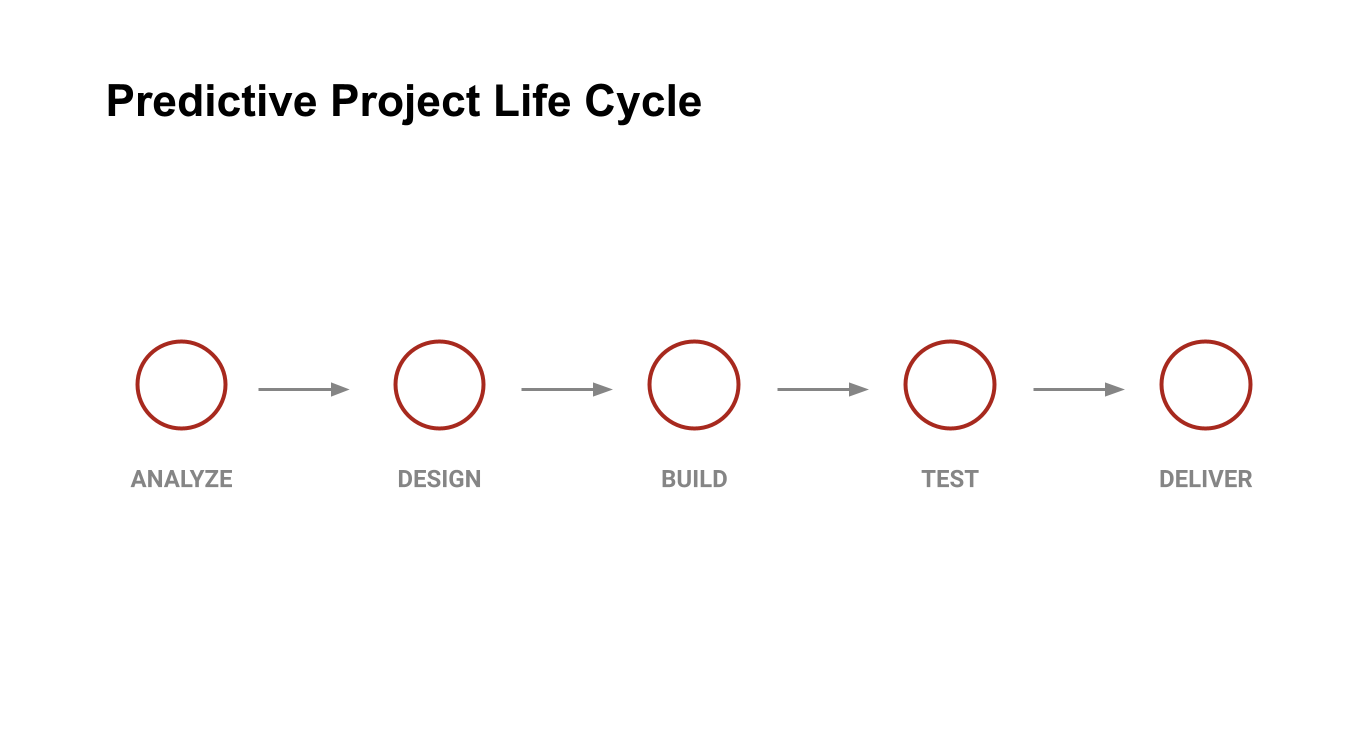
Coined by Winston Royce, the term "Waterfall" was introduced to software development, highlighting a linear progression from one phase to the next. Royce himself criticized its effectiveness in many cases, advocating for more flexible and rational approaches. For example, he suggested principles like "Do it twice" and "Involve customers," arguing against rigid planning due to its high risk and unpredictability.
The Waterfall approach, characterized by its sequential and inflexible nature, is rarely encountered even in less adaptive sectors. Its reliance on detailed upfront planning often leads to inefficiencies and failure to adapt to evolving project needs and technological advancements. This model assumes that requirements can be fully understood and defined at the outset, which is often unrealistic in complex projects.
Iterative and incremental approaches
While the Waterfall approach is native to industries where predictability and stability are paramount, its limitations have spurred the widespread adoption of iterative and incremental methods across various sectors.
Iterative and incremental approaches are a go-to in software development projects due to their evolving nature. Iteration involves repeating cycles of development, while increment refers to the addition of new functionality in each cycle. This approach, manifested by methodologies like Scrum, focuses on delivering workable increments of a product. For instance, an MVP of a mobile application might initially support taxi bookings and later incorporate features like credit card payments in its v1.
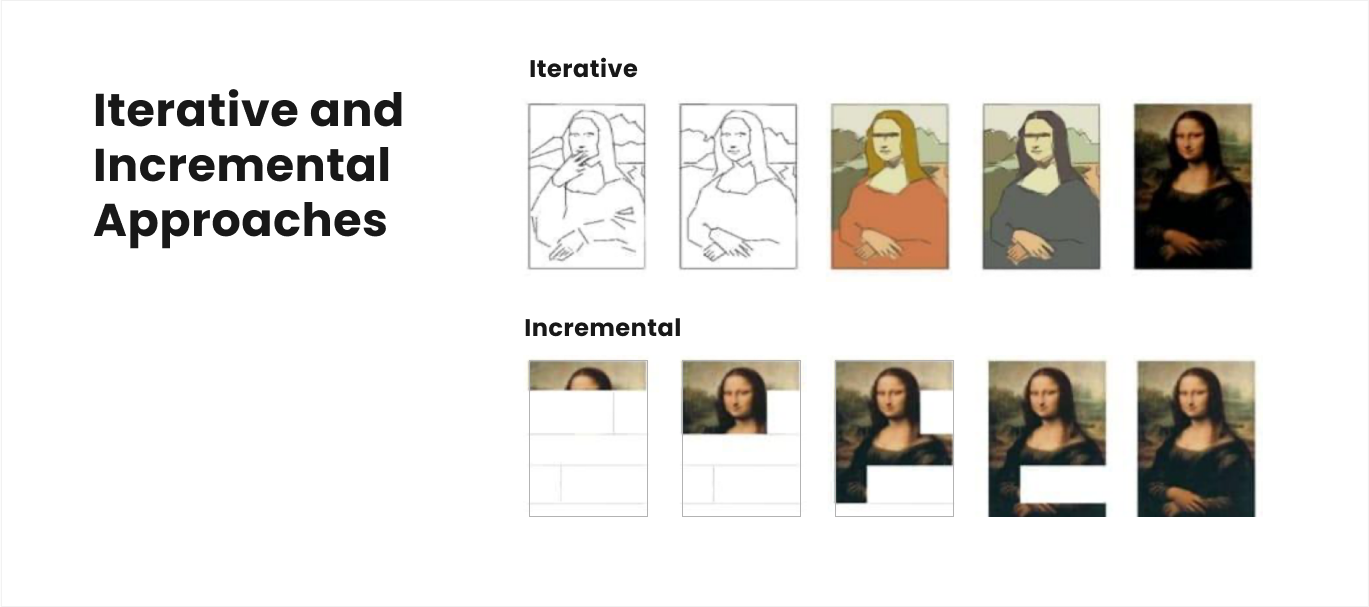
In iterative development, teams work in short cycles (iterations), typically lasting a few weeks, focusing on delivering usable features or improvements. Each iteration concludes with a review and planning session, promoting continuous improvement and alignment with project goals. Daily stand-up meetings help keep teams synchronized, enabling them to address issues promptly and adjust plans as needed. This continuous cycle provides flexibility to respond to feedback and changing requirements, in contrast to the rigid structure of the Waterfall model.
However, the iterative approach is best suited to product development, where flexibility and continuous improvement are prioritised over fixed deadlines. In contrast, traditional project management places greater emphasis on time, cost, and scope constraints, where strict deadlines and budgets are critical to success. For this reason, the classical PMI approach may offer a more effective framework for managing such projects.
Conclusion
Understanding and effectively managing the project life cycle is a fundamental prerequisite for the success of any project. By breaking down the project into distinct phases, it becomes easier to plan, execute, monitor, and close projects systematically and efficiently. Having a structured approach in place helps increase the odds of projects being completed on time, within budget, and up to the desired quality standards.
With Planyway for Jira, you can plan timelines, allocate resources, track progress, and stay aligned across every phase, without losing visibility along the way.


FAQ
A project life cycle (PLC) covers the processes related to the project itself, which can also include the business and market side of things. Software development life cycle (SDLC), on the other hand, focuses on the technical process of building software. While a PLC is more management-oriented, an SDLC has to do more with execution within software engineering.
According to the Project Management Institute (PMI), the five stages of a project life cycle are initiation, planning, execution, monitoring and controlling, and closure. These stages provide a structured framework for managing a project from start to finish, ensuring that objectives are clearly defined, work is properly planned and executed, progress is continuously tracked, and the project is formally completed with all deliverables acc
Scope creep has a negative effect on the project lifecycle because it throws uncontrolled changes into the pre-defined project requirements. As a result, it can disrupt the balance of the project management triangle by increasing costs, extending timelines, and placing pressure on resources.
A project life cycle is a structured model that breaks the project journey from the initial idea to its closure into logical stages. This approach helps divide complex work into manageable steps, control the budget and timelines, and achieve the set objectives.
The high-level logic of the project life cycle is similar across the models. However, it can be structured in different ways depending on how much predictability, wiggle room, and iteration the project calls for. The predictive project life cycle (Waterfall) supports a linear, sequential approach where each phase is completed before the next begins. Conversely, an incremental model assumes that the project is delivered in parts (increments), with each release adding new functionality.