
Herzberg two factor theory: a comprehensive guide to motivation

A manager is someone who compensates for a lack of authority through influence. Typically, functional managers wield much more authority than project managers. A crucial aspect that aids in exerting this influence is understanding what motivates team members. This is why it's essential for managers to be well-versed in employee motivation theories, one of which is Herzberg's Two Factor Theory, also known as Herzberg's motivation hygiene theory.
TL;DR:
- Herzberg's two factor theory is a workplace motivation model that says long-term job satisfaction stems from motivators like achievement and sense of ownership, while dissatisfaction can be prevented by hygiene factors like salary and working conditions.
- In project management, Herzberg's motivation hygiene theory can be applied as a diagnostic lens to identify whether team issues come from delivery friction or lack of engagement.
- The most common failure is misapplication, such as over-investing in perks or process fixes, while overlooking motivators.
What is Herzberg's theory?
Herzberg's two factor theory suggests that the things affecting how people feel and perform at work generally fall into two categories: hygiene factors and motivators.
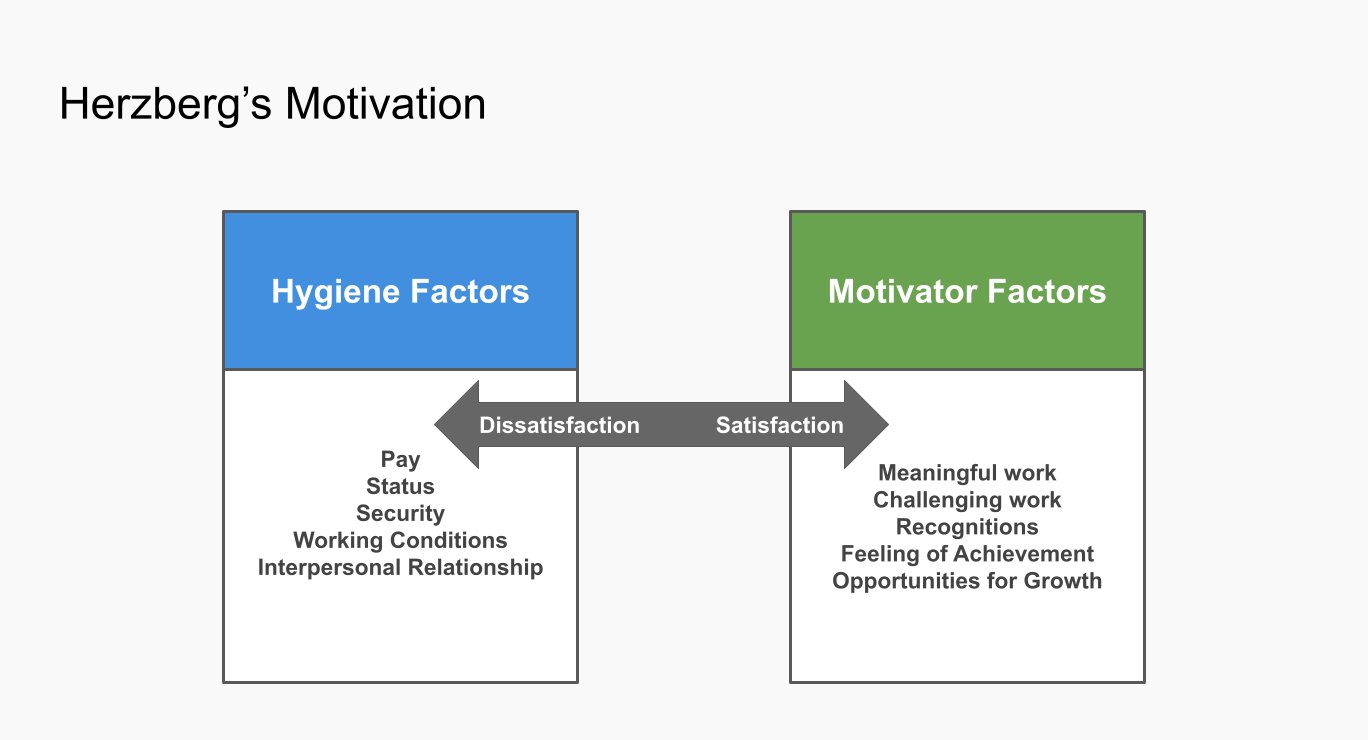
According to Frederick Herzberg, hygiene factors include aspects such as working conditions, salary, work-life balance, company policies, job security, and status. These are the essentials that, if absent or inadequate, can cause dissatisfaction. However, their presence doesn't necessarily improve job performance. They simply prevent job dissatisfaction.
Motivators, on the other hand, are the elements that truly drive individuals to perform better and increase job satisfaction. These include responsibility, personal growth opportunities, recognition and praise, and career advancement.
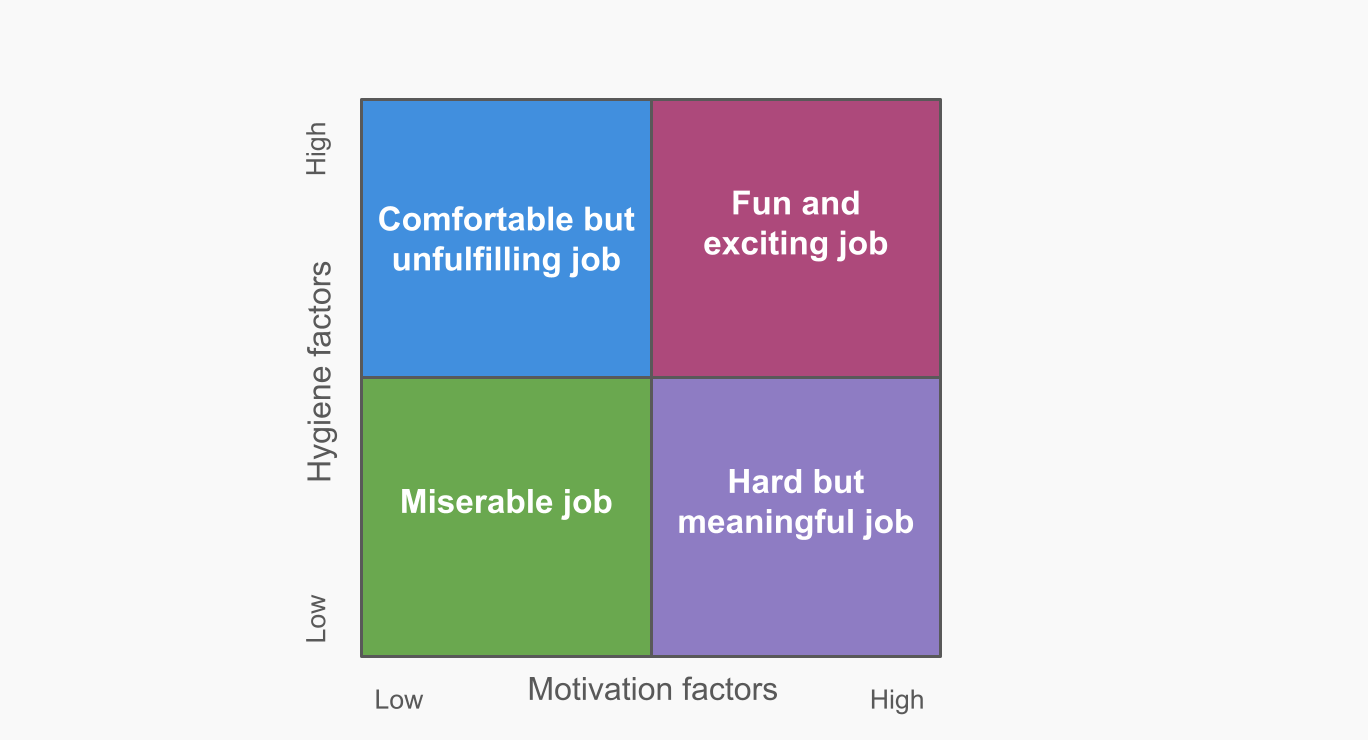
Herzberg argued that job factors are not a single scale from satisfied to dissatisfied. Instead, you can have low dissatisfaction (by fixing hygiene) and still have low motivation. In other words, you need motivators to move the needle.
Key hygiene factors
It’s critical to understand that hygiene factors alone do not motivate people to work harder or perform better. Their primary function is to determine whether an individual accepts a job offer or, to some extent, remains satisfied with their current position. Key hygiene factors include:
- Company policies — сlarity and fairness in organizational behavior (rules and procedures).
- Supervision — the quality of leadership and management support.
- Work conditions — the physical environment, tools, and resources provided.
- Salary — compensation that is perceived as fair and adequate.
- Relationships — the nature of interpersonal relations at work.
- Job security — assurance of continuity in one's job.
- Work-life balance — the ability to maintain a healthy balance between professional and personal life.
Key motivation factors
Motivators are the elements within a job that encourage individuals to strive for high performance. These factors are directly related to the content of the work itself. When employees feel that they are being given opportunities to grow, learn, and take on more responsibility, they are more likely to feel satisfied and motivated.
Examples of motivation factors include:
- Achievement — the sense of accomplishment that comes from completing meaningful tasks.
- Recognition — being acknowledged for a job well done.
- Work itself — engaging in work that is interesting and challenging.
- Responsibility — having control over one's work and being trusted with important tasks.
- Advancement — opportunities for career progression and growth.
- Personal growth — continuous learning and development.
One particularly interesting motivator is experience. People are often willing to go the extra mile to be part of a project they find meaningful and engaging or to collaborate with someone who can significantly contribute to their learning and development. In fact, learning opportunities in general add to employee satisfaction and motivation. Employees appreciate opportunities to develop new skills and gain knowledge, which motivates them to perform at their best.
The role of money in Herzberg's theory of motivation
Money, often viewed as a primary motivator, actually plays a nuanced role in Herzberg's theory. While it is undeniably important, Herzberg categorizes salary primarily as a hygiene factor rather than a motivator. This means that while fair and adequate compensation is essential to prevent dissatisfaction, simply increasing someone's pay will not necessarily enhance their motivation or job performance.
However, money can become a motivator if it is tied to certain conditions, such as performance-based bonuses or profit-sharing. In these cases, money goes beyond being just a hygiene factor and begins to act as a motivator by recognizing achievement and encouraging stronger performance.
Herzberg's two factor motivation theory in project management
Herzberg's two-factor theory fits the project management context exceptionally well because usually projects are temporary, often high-pressure, and are driven by the team’s discretionary effort. A project manager can’t afford a team that is merely not satisfied, since successful projects are run by people who are also deeply committed to the success of the project. It means that PMs have to address hygiene factors on par with extrinsic motivators.
Part 1: Managing hygiene factors (the baseline)
As a project manager, your primary goal is to get the sources of dissatisfaction out of the team’s way. If not attended to, those can dampen your team’s motivation even if the project itself is interesting. Here’s how some hygiene factors can play out during projects:
| Hygiene factor | Project management example | Consequence if poor |
|---|---|---|
| Company policies and admin work | Excessive time-tracking, unfair resource allocation across projects | Time wasting, feeling untrusted |
| Supervision | Micromanagement, unclear role definitions from the project sponsor, lack of technical guidance | Confusion, reduced autonomy, anxiety |
| Work conditions | Broken collaboration tools, slow VPN, noisy open office, lack of a war room | Frustration, lost productivity, burnout |
To this end, actions for PMs on hygiene can include proactively solving tool and environment issues, fighting bureaucratic battles for the team, and having clear, fair policies on hours and overtime in place.
However, as we've mentioned earlier, fixing hygiene factors alone won’t activate employee engagement to its full potential. While these factors make it possible for motivation to exist and promote job satisfaction, they’re not enough on their own. That’s why product managers also need to focus on adding motivators to the mix.
Part 2: Managing motivator factors (the engine)
Motivators are intrinsic to the work itself. When present, they create genuine satisfaction, energy, and commitment. When lacking, they leave the team emotionally neutral, which means they are not necessarily dissatisfied, but they tend to do the bare minimum.
| **Motivator factor** | **Project management example** | **Impact on the team** |
|---|---|---|
| Achievement | Completing a crucial milestone, delivering a feature under budget | Pride, euphoria, desire for the next challenge |
| Recognition | A personal thank-you email from the PM, public recognition in a stakeholder meeting | Validated effort, increased loyalty |
| Responsibility | Making a junior dev the "tech lead" for a sub-component. Letting a team member represent the project at a client demo | Accountability, growth, empowerment |
| Growth | Learning a new cloud platform during the project. | Mastery |
For a PM, general recommendations on managing the motivators include:
- Designing jobs for meaning, i.e., explaining the bigger why behind the task to the team.
- Delegating real responsibility to the people and allowing them to take charge of a deliverable from start to finish.
- Recognizing the team’s effort in time and in a meaningful way.
- Creating opportunities for achievement by setting clear but realistic sprint goals.
Common PM mistakes when applying Herzberg's two-factor theory
The Herzberg two-factor theory is a good place for project managers to start, because it gives a practical framework for understanding what actually makes a difference for the team and how to improve the team dynamics overall. However, it's easy to play it wrong in ways that negate its positive value entirely, or worse, compound the problem. Typical mistakes include:
- Covering hygiene factors only — If the company doubles down exclusively on hygiene factors, like free coffee and a ping-pong table, while ignoring motivation factors like ownership, professional development, or recognition, they get a comfortable but uninspired team. PMs can contribute to this by focusing solely on process improvements and organizational comfort vs. autonomy and impact.
- Bolting motivator factors on top of poor hygiene — When project managers try to fix morale without taking care of the system basics, motivator factors, however tangible, are rendered ineffective. The delivery environment stays chaotic and unstable, while things like recognition programs and team-building initiatives are seen as noise layered on top of unresolved delivery pain.
- Assuming money is all it takes — Sometimes, PMs think that higher pay is an ultimate solution to motivation problems. But as we've mentioned earlier, salary is primarily a hygiene factor. Once it's fair, more money has diminishing returns. Recognition and achievement matter more.
- Praising someone for basic compliance — Giving credits for trivial or basic tasks just for the sake of it can feel patronizing rather than motivating. Recognition should be saved for genuine achievements that involve real impact, ownership, or problem-solving.
Conclusion
Understanding Herzberg’s theory can provide managers with the insights needed to create a more motivating work environment. While ensuring hygiene factors are adequately addressed is important, true motivation comes from focusing on the elements that drive personal and professional growth. By recognizing and leveraging these motivators, managers can foster a more engaged and productive workforce.


FAQ
The two-factor theory of motivation, also dubbed the dual factor theory or Herzberg's motivation theory, breaks workplace factors into two groups, including motivating factors (motivators) and hygiene factors. Motivators, like challenging tasks, professional development, or recognition, create satisfaction and truly motivate employees to do their best. Hygiene factors remove dissatisfaction, but they do not automatically contribute to high job satisfaction.
A textbook example of the two-factor theory is salary. Through the lens of Herzberg's dual factor theory, salary is primarily a hygiene factor because it doesn't foster long-term motivation on its own. However, if unfair or uncompetitive, it can lead to dissatisfaction. Also, increasing a team member's salary can temporarily improve morale or patch up complaints, but it won't improve ownership or intrinsic motivation long-term.
Like Maslow's hierarchy of needs and McClelland's Theory of Needs, Herzberg's theory is an ever-relevant concept. However, it serves more as a practical mental model than a complete explanation of workplace motivation.
According to Herzberg's motivation theory, hygiene factors stand for job factors meant to prevent dissatisfaction in the workplace. However, they can't turn satisfied employees into motivated employees on their own. To prompt motivation, that baseline needs to be supplemented by other elements like the sense of ownership and recognition, which fall into the category of motivators.
Common hygiene factors that add to overall job satisfaction include compensation, company policies, working conditions, management quality, and interpersonal relationships. All these support employees in their daily work by reducing friction and promoting more stable and predictable working conditions.